I7 8550u 512gb Ssd 16gb Dell Inspiron Review
Dell Inspiron 15 7570 (i7-8550U, 940MX) Laptop Review
Top outside, top inside, but ... The new Dell aims to succeed with powerful and high-quality components. Volition the all-rounder also convince usa in the test and earn a purchase recommendation?
For the original German review, come across here.
At this signal, there are numerous models from the Dell Inspiron fifteen serial: gaming notebooks with various Nvidia or AMD graphics cards, concern models without a dedicated graphics card or with a smaller version, many different designs, etc. All are called "Inspiron 15," which can become confusing to the customer.
They are differentiated by the long number that follows the designation. Today we are testing the device with the long name "Dell Inspiron 15 7000 (7570-9726)." This is a business or all-round device with the new Kaby Lake processor and the GTX 940MX by Nvidia. (A similar model starts from $780 in the US.)
We are evaluating the new Inspiron, comparing it against the Asus VivoBook S15 S510UQ, the Acer TravelMate P658-G2, the Lenovo IdeaPad 510-15IKB, and the Huawei MateBook D. While all these models are also equipped with a GTX 940MX, their processors are different, even if they are e'er Kaby Lake CPUs. As the fifth comparison device, we have selected the Inspiron xv 5000 5567-1753 also from Dell. Even though it has an AMD GPU, its performance is at near the same level as that of the 940MX.
Graphics adapter
NVIDIA GeForce 940MX - 4096 MB, Core: 1242 MHz, Memory: 4000 MHz, GDDR5, 22.21.13.8178, Nvidia Optimus
Memory
8192 MB
, 1 of 2 slots occupied
Brandish
15.threescore inch 16:nine, 1920 10 1080 pixel 141 PPI, BOE06B4, IPS, glossy: yes
Mainboard
Intel Kaby Lake-U + iHDCP two.2 Premium PCH
Weight
1.995 kg ( = 70.37 oz / four.4 pounds), Ability Supply: 327 yard ( = xi.53 oz / 0.72 pounds)
Note: The manufacturer may use components from different suppliers including display panels, drives or memory sticks with similar specifications.
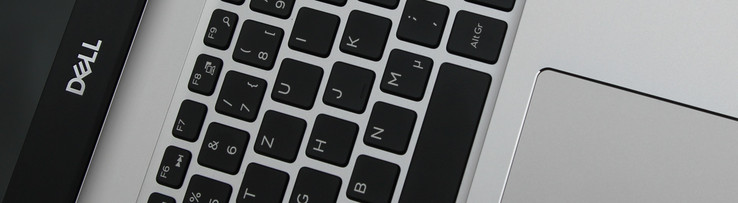
According to the manufacturer, the instance is made of aluminum with "drinking glass-bead brilliance." Whether there are glass beads or not, the silver aluminum case provides good stability and a loftier-quality appearance to the new Inspiron. The design is kept nicely small-scale, only the cogitating "Dell" logo stands out in the center of the top.
The bottom with the keyboard base of operations is comfortably sturdy, and there are no creaks when pressing down on it. The same goes for the chapeau, although naturally it is not quite as robust. Considering of the aluminum, information technology appears more than resistant than some of the plastic competitors. The chapeau cannot be opened with one hand, due to the relatively light base and the stability of the hinges, which hold the display in position well.
The openings for the speakers are at the bottom in the front end, and the fan vents are further back. The battery is built-in, and there is no maintenance hatch.
The gaps betwixt the top holding the keyboard and the bottom edge are non always completely even. In some places, the gaps turn out slightly larger. However, the workmanship in our examination unit leaves a good impression overall.

Behind the Huawei,our test unit of measurement is the smallest model, and the Asus has about the same size. These two competitors are also even slightly slimmer than the Dell. The Asusis also the lightest device, followed by the Huawei. Overall, the Inspiron achieves a good third place in terms of its size and weight.
❌
The Inspiron offers all the usual connections. USB 2.0 is history, but unfortunately we are missing Thunderbolt 3. Instead, one of the USB-A ports offers back up for PowerShare and the USB-C port supports DisplayPort. All the connections are on the sides of the notebook, most of them on the left. This is adept for right-handed users, but non and then good for left-handed ones. The distances betwixt the ports are okay, just could have been even larger on the left side, since in that location is notwithstanding plenty of space towards the front end.
Nosotros are testing the transfer speeds of the bill of fare reader with our Toshiba Exceria Pro SDXC 64 GB UHS-Two reference storage card. Unfortunately, the standard device does not strike such a skillful figure. In the JPG-file copy test, merely the sibling model does worse, and in the sequential read exam, the Lenovo besides joins this boring grouping. For comparison, the Acer, which ranked highest in both SD tests, performed 150 to 230% better than the Inspiron!
Things look much amend in the test of the advice module. Our test unit of measurement accomplished 2d place during sending also as receiving. Merely the Huawei and the Asus are similarly fast here.
Apart from a Kensington security lock, we did not see any other security features.
The manufacturer is stingy in terms of accessories, and apart from a quick-start manual and a warranty card, in that location is cypher else in the box of the Inspiron 15. Even so, Dell offers a range of external accessories, such as numberless, docking stations, additional batteries, optical drives, and more than. None of these accessories are exclusive to this model, so nosotros are not including them in our testing. Dell's website offers farther data.
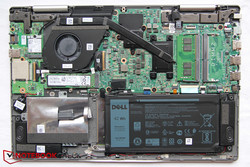
The Inspiron does non take a maintenance hatch, but you tin can remove the entire base plate. In order to practice this, you accept to first remove x visible screws. Afterwards, it is non that easy to detect a point of leverage to remove the bottom. The best place is at the back, in the middle between the two hinges. After loosening and taking off the bottom, you get admission to the RAM slots, the battery, the SSD, and the empty SATA slot, equally well every bit the fan.
Keyboard
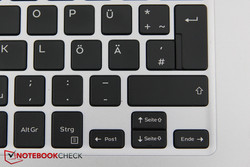
The xv 10 15 mm (~0.6 x 0.6 in) keys offer a comfortable keystroke. Typing with them is simple and straightforward, and the typing noise is also okay. Moreover, the layout is extremely clean, and there is plenty of space for all the keys. Notwithstanding, this is due to the fact that there is no number pad. In a 15-inch device which is advertised as a business or all-round device, we would have actually liked a number pad, since it makes a lot of tasks easier. Despite the ample corporeality of space, the Shift, Enter, and particularly the arrow keys are smaller than usual.
The mapping of the part keys is unusual, since their default is prepare to the special functions. For example, pressing F5 does not reload a website, only triggers the special media function of the key (Play/Suspension). Even so, Dell is non consistent here - that would be impractical - but some keys do the opposite (for example F4). Since there is no additional labeling, you have to observe out by trial and mistake.
You tin optionally illuminate the keyboard in a unmarried colour and 2 steps of brightness, although the deviation betwixt them is very slight.
Touchpad
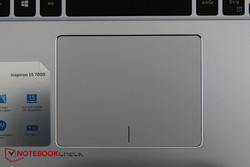
The touchpad has a proficient size (105 x 81 mm/~4.ane x iii.2 in), reacts accurately, and offers a pleasing sliding characteristic. The key expanse too reacts reliably, but the clicking noises could accept been quieter. Multi-touch gestures were likewise recognized in the test without whatever problems. Dragging and swiping actions worked with upwards to 4 fingers.
In our test unit, Dell has used a 15-inch Full Hard disk IPS console made by BOE. Optionally, y'all can besides become a (much more than expensive) version with a 4K UHD display including the bear upon function. While the display used is convincing in many respects, it also has two or iii weaknesses. Probably the biggest weakness of the display is the relatively low boilerplate brightness of 240 cd/chiliadii. With the exception of the mediocre TN console of the sibling model, this is the worst value in the comparison. However, at a maximum of 275 cd/chiliadii the competitors are non much meliorate either. In addition, the brandish of the new Inspiron is as well reflective. The combination of the barely adequate brightness and reflective surface creates some doubts every bit to the outdoor suitability of the device. But more on this subsequently.
At 91%, the brightness distribution turns out very strong, and so the brightness is distributed very evenly across the display. As typical for IPS displays, we too noticed some slight screen bleeding. This was mainly in the top correct corner visible in very dark scenes and that but when yous were looking for it.
| 243 cd/k² | 231 cd/g² | 236 cd/m² | ||
| 239 cd/k² | 255 cd/m² | 232 cd/grand² | ||
| 240 cd/m² | 243 cd/g² | 237 cd/m² | ||
Distribution of brightness
BOE06B4
X-Rite i1Pro two
Maximum: 255 cd/m² (Nits) Boilerplate: 239.6 cd/m² Minimum: 18.2 cd/chiliad²
Brightness Distribution: 91 %
Centre on Battery: 255 cd/thou²
Contrast: 1594:i (Black: 0.sixteen cd/m²)
ΔE Color iv.74 | 0.59-29.43 Ø5.4
ΔE Greyscale 3.44 | 0.64-98 Ø5.6
threescore% sRGB (Argyll 1.half dozen.3 3D)
38% AdobeRGB 1998 (Argyll 1.6.3 3D)
41.77% AdobeRGB 1998 (Argyll ii.two.0 3D)
threescore% sRGB (Argyll 2.2.0 3D)
40.43% Display P3 (Argyll 2.2.0 3D)
Gamma: two.43
| Dell Inspiron 15 7570 BOE06B4, , 1920x1080, 15.60 | Asus Vivobook S15 S510UQ-BQ189T AU Optronics B156W02 / AUO B156HAN02.ane, , 1920x1080, 15.60 | Acer TravelMate P658-G2-MG-7327 LG Philips LP156WF6-SPP1, , 1920x1080, 15.60 | Lenovo IdeaPad 510-15IKB 80SV0087GE BOE HF NV156FHM-N42, , 1920x1080, 15.sixty | Huawei MateBook D 15, i7-7500U 940MX BOE070C, , 1920x1080, 15.60 | Dell Inspiron 15 5000 5567-1753 BOE NT15N41, , 1920x1080, xv.60 | |
|---|---|---|---|---|---|---|
| Display | -3% | 51% | half-dozen% | 3% | -10% | |
| Display P3 Coverage | xl.43 | 38.94 -4% | 64.nine 61% | 42.66 6% | 41.79 3% | 36.24 -10% |
| sRGB Coverage | 60 | 58.five -two% | 85.9 43% | 64.1 7% | 61.v iii% | 54.6 -ix% |
| AdobeRGB 1998 Coverage | 41.77 | forty.23 -four% | 62.8 50% | 44.08 6% | 43.17 3% | 37.44 -10% |
| Response Times | six% | 680% | -41% | 671% | 31% | |
| Response Time Greyness 50% / Grey 80% * | 45 ? | 47 ? -4% | 38 ? 16% | 51 ? -13% | 46.4 ? -3% | 43 ? 4% |
| Response Time Black / White * | 33 ? | 28 ? fifteen% | 28 ? 15% | 38 ? -15% | 36.8 ? -12% | xiv ? 58% |
| PWM Frequency | 996 ? | 21000 ? 2008% | 50 ? -95% | 21190 2028% | ||
| Screen | -one% | -3% | -6% | -45% | -86% | |
| Brightness middle | 255 | 293 xv% | 284 11% | 291 fourteen% | 268 five% | 145 -43% |
| Effulgence | 240 | 275 15% | 276 15% | 265 x% | 258 eight% | 144 -twoscore% |
| Brightness Distribution | 91 | 86 -v% | 82 -x% | 86 -5% | 92 one% | 90 -1% |
| Blackness Level * | 0.16 | 0.25 -56% | 0.295 -84% | 0.23 -44% | 0.47 -194% | 0.49 -206% |
| Dissimilarity | 1594 | 1172 -26% | 963 -forty% | 1265 -21% | 570 -64% | 296 -81% |
| Colorchecker dE 2000 * | 4.74 | 3.81 20% | iv.07 xiv% | 4.78 -ane% | 5.vii -xx% | 9.27 -96% |
| Colorchecker dE 2000 max. * | vii.68 | 6.64 14% | 10.52 -37% | nine.51 -24% | 21.vii -183% | 16.9 -120% |
| Greyscale dE 2000 * | 3.44 | 2.66 23% | 3.13 9% | 3.49 -ane% | 4.2 -22% | 12.28 -257% |
| Gamma | two.43 91% | ii.54 87% | 2.41 91% | ii.58 85% | 2.3 96% | 2.03 108% |
| CCT | 7064 92% | 6541 99% | 7082 92% | 6013 108% | 6820 95% | 10732 61% |
| Color Infinite (Percentage of AdobeRGB 1998) | 38 | 37 -three% | 56 47% | 40 5% | 43.2 14% | 35 -8% |
| Color Space (Percent of sRGB) | 60 | 58 -3% | 86 43% | 64 7% | 61.5 iii% | 55 -viii% |
| Total Average (Program / Settings) | one% / -0% | 243% / 135% | -xiv% / -ten% | 210% / 98% | -22% / -55% |
* ... smaller is better
In many other measurements, the panel is convincing. This is the case particularly for the very good contrast (1594:i) and blackness value (0.xvi). Both values are the best of the direct comparison and ensure that the display is besides very pleasing subjectively. The impression of the very good contrast and saturated black is fifty-fifty more emphasized past the reflective screen, which makes the colors announced even more saturated, at least indoors. The color deviations and the grayscales are as well in the adequate range.
The panel is manifestly using PWM for brightness control. The technology is used from a brightness of 90% and lower at a frequency of 996 Hz, which should exist sufficiently high to non exist noticeable even by sensitive people.
Even though the color space coverage is just important for (semi-) professional users, it should be mentioned. At 60% sRGB and 38% AdobeRGB, this is not particularly high, merely almost all of the direct competitors have similar values. Only the Asus tin practise improve here (86% and 56%). Subjectively, we liked the brandish very much overall, and but the mediocre effulgence marred the impression slightly.
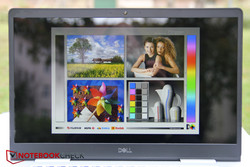
Since this year'south terminate of Oct and beginning of November were non blessed by much sun, we were only able to test the outdoor suitability of the Inspiron xv on a cloudy day. Despite the reflective screen and only mediocre brightness, it fared surprisingly well, which is mainly due to the strong contrast and excellent black value. But of grade, you notwithstanding have to alive with the reflections. Withal, even then the brandish contents remain surprisingly visible. However, in directly sunlight the visibility volition be reduced further.
Display Response Times
ℹ
Display response times show how fast the screen is able to change from one colour to the next. Slow response times can lead to afterimages and tin can crusade moving objects to appear blurry (ghosting). Gamers of fast-paced 3D titles should pay special attention to fast response times.
| ↔ Response Time Black to White | ||
|---|---|---|
| 33 ms ... rising ↗ and fall ↘ combined | ↗ 18 ms rise |  |
| ↘ fifteen ms fall | ||
| The screen shows boring response rates in our tests and volition exist unsatisfactory for gamers. In comparison, all tested devices range from 0.viii (minimum) to 240 (maximum) ms. » 86 % of all devices are ameliorate. This means that the measured response fourth dimension is worse than the boilerplate of all tested devices (23.5 ms). | ||
| ↔ Response Fourth dimension 50% Greyness to 80% Greyness | ||
| 45 ms ... rise ↗ and fall ↘ combined | ↗ 23 ms rise |  |
| ↘ 22 ms fall | ||
| The screen shows ho-hum response rates in our tests and will exist unsatisfactory for gamers. In comparison, all tested devices range from 0.692 (minimum) to 636 (maximum) ms. » 69 % of all devices are better. This ways that the measured response time is worse than the average of all tested devices (37.1 ms). | ||
Screen Flickering / PWM (Pulse-Width Modulation)
ℹ
To dim the screen, some notebooks volition but wheel the backlight on and off in rapid succession - a method chosen Pulse Width Modulation (PWM) . This cycling frequency should ideally exist undetectable to the human heart. If said frequency is besides low, users with sensitive eyes may experience strain or headaches or even observe the flickering altogether.
| Screen flickering / PWM detected | 996 Hz | ≤ 90 % brightness setting |  |
| The display backlight flickers at 996 Hz (Likely utilizing PWM) Flickering detected at a brightness setting of 90 % and below. There should be no flickering or PWM higher up this brightness setting. The frequency of 996 Hz is quite high, so most users sensitive to PWM should not observe any flickering. In comparison: 52 % of all tested devices exercise non employ PWM to dim the brandish. If PWM was detected, an average of 22039 (minimum: 5 - maximum: 3846000) Hz was measured. | |||
Despite the reflective brandish, the viewing angle stability is very good, at least indoors. Outdoors, reflections will probably interfere with the view of the contents. The image below shows the display from diverse viewing angles of about 45 degrees.

The equipment of the Inspiron xv combines an Intel Core i7-8550U with an Nvidia GeForce 940MX, 8 GB of working memory, and a potentially fast SSD from Samsung. With these performance characteristics, the device targets mainly business and function users, graphics editors, and also video editors. Nevertheless, this notebook is not really recommended to gamers since the born graphics are too weak.
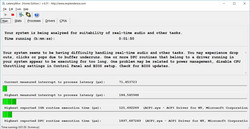
In the test, the LatencyMon tool showed latencies and the risk of drop outs while playing real-time audio and other applications. A BIOS update is recommended, the Performance power profile was selected, and throttling was not set up.
The Intel Core i7-8550U is an energy-efficient processor of the Kaby-Lake-refresh generation. The power consumption is simply 15 watts. Thanks to Hyperthreading, its four cores are able to run ii threads each. They have a very variable clock speed of 1.8 to 4 GHz. The decisive factor is the cooling organization and notebook configuration, determining whether the CPU tin employ its total operation potential or it is throttled because of high temperatures.
In our thirty-infinitesimal Cinebench loop, the typical behavior of the ultra-efficient CPU is showing. After the beginning, strong run, the values decline in the 2nd run and so level off. For a short time, the CPU can go up to 44 watts, which means that the showtime run is not actually representative. The outliers downwards trend without an external cause is striking. Perhaps in that location are some specific groundwork processes that interfere with the performance, but nosotros practise not know the existent reason.
The values that the sensors report via HWiNFO are likewise surprising. By just starting Cinebench, the core temperature jumps from fifty - seventy °C (~122 - ~158 °F) up to 98 °C (~208 °F) for a brief time, before they lower again to 71 °C (~160 °F). Such a sudden temperature alter is not very probable, so we must question the information of the sensors on the core temperature.
In bombardment mode, the clock speed is 3.4 to iii.five GHz on average. Away from the outlet, these values are decent. However, they also vary. If you run simply the multi-core test, they barely boilerplate out at 2.four GHz. In this manner, the notebook achieves a value of about 526 points from the second run on. Compared to the 565 points when plugged in, this is simply a slight throttling of almost 7%.
Cinebench R15 CPU Multi 64 Chip
The performance comparing to the other notebooks is a chip difficult here, since they are using the weaker Cadre i7-7500U predecessor CPU, and the Asus has simply an i7-7200U. The predecessor serial has only two existent calculating cores and can therefore only operate on half the amount of threads. Accordingly, information technology is not very surprising that the Inspiron 15 7570 comes out on top in the Cinebench tests. The differences are relatively constant across all Cinebench versions: in the unmarried-cadre test our test unit more often than not leads by 12% at to the lowest degree, and in the multi-core test it is even alee of the remainder of the devices by at least forty%.
For a better comparison of the processor, we also use the Acer Aspire 5 A517-51G and the Acer Swift three, which take the same CPU as the Inspiron 15, just a different graphics card, and their sizes are also different (17-inch and 14-inch). Apparently the relatively new CPU has not been used much in 15-inch notebooks of the same cost range until now. In the comparing, the 3 devices produce very similar results, so the CPU-operation of the Inspiron fifteen lies within the expected range. You tin can notice more information and benchmark results in our database on the i7-8550U.
Cinebench R10 Shading 64Bit
6840 Points
Cinebench R10 Rendering Multiple CPUs 64Bit
25854 Points
Cinebench R10 Rendering Single CPUs 64Bit
8382 Points
Cinebench R11.v CPU Multi 64Bit
7.01 Points
Cinebench R11.5 OpenGL 64Bit
70 fps
Cinebench R11.5 CPU Single 64Bit
1.93 Points
Cinebench R15 CPU Unmarried 64Bit
170 Points
Cinebench R15 Ref. Friction match 64Bit
99.vi %
Cinebench R15 OpenGL 64Bit
81 fps
Cinebench R15 CPU Multi 64Bit
565 Points
Assist
In guild to evaluate the system functioning via PCMark 8, we are using the 2 additional Acer models with the same CPU for comparison. To avoid the comparing becoming likewise large, nosotros are leaving out the Acer TravelMate and the Dell sibling model. The results testify that the 3 devices with the amend CPU cannot really intermission away from the remainder of the field. Simply the Asus is e'er 8 to 10% behind the rest. Despite having only two cores, the Huawei is able to keep up well confronting the Inspiron 15 and is nearly at the aforementioned level. The Acer Swift 3 and the Aspire 5 are almost 4 to 5% ahead of the Inspiron. However, in practise the slight advantage should non be very noticeable.
| PCMark 8 | |
| Home Score Accelerated v2 | |
| Acer Swift iii SF314-52G-89SL | |
| Acer Aspire five A517-51G-80L | |
| Lenovo IdeaPad 510-15IKB 80SV0087GE | |
| Dell Inspiron xv 7570 | |
| Huawei MateBook D 15, i7-7500U 940MX | |
| Asus Vivobook S15 S510UQ-BQ189T | |
| Work Score Accelerated v2 | |
| Acer Aspire 5 A517-51G-80L | |
| Dell Inspiron 15 7570 | |
| Huawei MateBook D 15, i7-7500U 940MX | |
| Asus Vivobook S15 S510UQ-BQ189T | |
| PCMark eight Home Score Accelerated v2 | 3778 points | |
| PCMark 8 Work Score Accelerated v2 | 4987 points | |
| PCMark x Score | 3701 points | |
| Assist | ||
A 512 GB Samsung PM961 SSD is used as the principal storage. In our criterion list, this model is i of the fastest SSDs e'er, leading our list. Our measurements confirm the expert operation of the NVMe disk; it is past far the best storage medium in the direct comparison with the competitors. So information technology is fifty-fifty more than surprising that the Inspiron fifteen was unable to proceeds more than of an advantage in the system functioning via PCMark. Possibly the very variable clock speed of the CPU is responsible, since it can only rarely use its full potential (see Cinebench loop in a higher place).
Sequential Read: 2013 MB/southward
Sequential Write: 1015 MB/due south
CDM 5/6 Read Seq Q32T1: 3205 MB/s
CDM 5/6 Write Seq Q32T1: 1611 MB/s
CDM 5/6 Read 4K Q32T1: 407.2 MB/s
CDM 5/half-dozen Write 4K Q32T1: 637 MB/s
CDM v Read Seq: 1706 MB/s
CDM 5 Write Seq: 955 MB/s
CDM 5/half dozen Read 4K: 41.02 MB/southward
CDM 5/6 Write 4K: 131.8 MB/south
Sequential Read: 1800MB/s
Sequential Write: 271.5MB/southward
Access Time Write: four.391ms
The built-in graphics card is an Nvidia GeForce 940MX. At that place are at least two versions of this, and fortunately Dell is using the faster variant with GDDR5 storage (4 GB). This leads to the menu having about a 25% advantage to the version with GDDR3 storage. But in that location are also two different versions of the model with GDDR5 storage. Whereas this is a model with 384 shaders, there is likewise supposed to be a version with 512 shaders, which has a slightly slower clock speed instead. You tin can discover additional information on this on our special page for the model.
It will probably display the current games smoothly only in depression to medium details at resolutions of around 1366x768. Thus the Inspiron 15 is suitable for the occasional gamer at almost, but the real usage expanse is rather in the office or to edit photos and videos.
The Huawei is on elevation in all three 3DMark tests. While the Huawei also has a 940MX GPU with GDDR5 storage, the Mate model has just 2 GB of video storage. The shader amount should besides be similar, so the advantage of 10% (Cloud Gate) and 29 % (Fire Strike) is surprising. At to the lowest degree in 3DMark eleven, the Inspiron can achieve 2d place behind the Huawei. In Fire Strike information technology is simply plenty for third place, since fifty-fifty the Asus is 9% faster hither. Apparently, even during regular operation the graphics of the Inspiron are throttled slightly.
In battery performance, the Fire Strike criterion does not run during our starting time try, but at the second effort it works. The upshot is not much different from that in mains operation, and so at that place is no throttling.
| 3DMark 11 - 1280x720 Performance GPU | |
| Huawei MateBook D 15, i7-7500U 940MX | |
| Dell Inspiron 15 7570 | |
| Asus Vivobook S15 S510UQ-BQ189T | |
| Acer TravelMate P658-G2-MG-7327 | |
| Lenovo IdeaPad 510-15IKB 80SV0087GE | |
| Dell Inspiron 15 5000 5567-1753 | |
| 3DMark | |
| 1280x720 Cloud Gate Standard Graphics | |
| Huawei MateBook D 15, i7-7500U 940MX | |
| Asus Vivobook S15 S510UQ-BQ189T | |
| Dell Inspiron 15 7570 | |
| Dell Inspiron 15 5000 5567-1753 | |
| 1920x1080 Burn Strike Graphics | |
| Huawei MateBook D fifteen, i7-7500U 940MX | |
| Asus Vivobook S15 S510UQ-BQ189T | |
| Dell Inspiron 15 7570 | |
| Dell Inspiron 15 5000 5567-1753 | |
| 3DMark eleven Performance | 3065 points | |
| 3DMark Cloud Gate Standard Score | 10661 points | |
| 3DMark Fire Strike Score | 1898 points | |
| Help | ||
Every bit already mentioned, the 940MX is not suitable for serious gaming. While it offers slightly more than operation than the integrated graphics unit of measurement, and both can be switched via Nvidia Optimus, the current games are not very enjoyable in minimum detail. You can run across in the criterion results that the graphic performance is quite reduced, since the competing models with the same carte achieve higher frame rates.
For example, even in the lowest resolution and the everyman details, it cannot really display "The Witcher 3" smoothly. The Inspiron 15 7570 achieves 26 FPS on average in these settings. Anything more that is not playable anyway. Normally notebooks with the 940MX reach about 35 FPS hither, then the functioning is throttled.
At least yous can play "Ascent of the Tomb Raider" smoothly in the minimum settings, but is in that location anyone who wants to do this? Even in medium settings, Lara moves only at a snail's pace.
Even at its lowest settings, "Doom" became a benchmark torture for the tester. Most xiv FPS in the minimum configuration is not comfortable to test, but the device is not really a gaming but rather a business model. Commonly "Doom" is less demanding than "The Witcher 3." Since notebooks with the 940MX unremarkably achieve about 39 FPS and "Doom" is our final game of the test series, we definitely saw additional throttling over fourth dimension here.
The general throttling of the graphics performance and the additional throttling over time have a negative event on the comparison with the competitors. Most of the fourth dimension, the Inspiron 15 tin can be found in one of the last places, and the Huawei and the Asus mostly fare much better. Simply the results in the other models are too quite variable, depending on the resolution and details.
Finally, we have to negate the gaming suitability of the Inspiron 15 7570. While information technology might still exist enough for a game of "Rocket League" or one of the older "FIFA" games in much reduced settings, the device does non have sufficient power for the electric current, demanding games. But this is Dell'due south fault, since the graphics card should at least do a piffling better and enable playing games in the lowest settings. However, the performance is throttled considerably at times.
| The Witcher 3 | |
| 1024x768 Low Graphics & Postprocessing | |
| Asus Vivobook S15 S510UQ-BQ189T | |
| Huawei MateBook D 15, i7-7500U 940MX | |
| Dell Inspiron fifteen 5000 5567-1753 | |
| Dell Inspiron 15 7570 | |
| 1366x768 Medium Graphics & Postprocessing | |
| Asus Vivobook S15 S510UQ-BQ189T | |
| Huawei MateBook D fifteen, i7-7500U 940MX | |
| Dell Inspiron 15 7570 | |
| Dell Inspiron xv 5000 5567-1753 | |
| 1920x1080 High Graphics & Postprocessing (Nvidia HairWorks Off) | |
| Huawei MateBook D xv, i7-7500U 940MX | |
| Dell Inspiron 15 7570 | |
| Dell Inspiron 15 5000 5567-1753 | |
| 1920x1080 Ultra Graphics & Postprocessing (HBAO+) | |
| Dell Inspiron 15 7570 | |
| Huawei MateBook D fifteen, i7-7500U 940MX | |
| Dell Inspiron xv 5000 5567-1753 | |
| Rising of the Tomb Raider | |
| 1024x768 Lowest Preset | |
| Asus Vivobook S15 S510UQ-BQ189T | |
| Dell Inspiron xv 7570 | |
| Dell Inspiron 15 5000 5567-1753 | |
| Huawei MateBook D 15, i7-7500U 940MX | |
| 1366x768 Medium Preset AF:2x | |
| Asus Vivobook S15 S510UQ-BQ189T | |
| Huawei MateBook D 15, i7-7500U 940MX | |
| Dell Inspiron xv 5000 5567-1753 | |
| Dell Inspiron fifteen 7570 | |
| 1920x1080 High Preset AA:FX AF:4x | |
| Huawei MateBook D xv, i7-7500U 940MX | |
| Dell Inspiron 15 7570 | |
| Dell Inspiron xv 5000 5567-1753 | |
| 1920x1080 Very Loftier Preset AA:FX AF:16x | |
| Huawei MateBook D xv, i7-7500U 940MX | |
| Dell Inspiron 15 7570 | |
| Dell Inspiron 15 5000 5567-1753 | |
| Doom | |
| 1280x720 Low Preset | |
| Dell Inspiron fifteen 5000 5567-1753 | |
| Dell Inspiron 15 7570 | |
| 1366x768 Medium Preset | |
| Dell Inspiron 15 5000 5567-1753 | |
| Dell Inspiron 15 7570 | |
| 1920x1080 Loftier Preset AA:FX | |
| Dell Inspiron 15 5000 5567-1753 | |
| Dell Inspiron fifteen 7570 | |
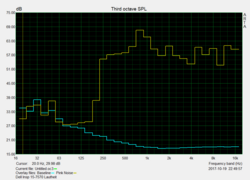
Co-ordinate to the measurements, the dissonance evolution of the Dell Inspiron 7570 is quite decent, especially during idle. In parts, the fans are completely deactivated when at that place is no load, and the device is silent. But the residual of the competitors also produce around 30 dB(A) during idle, and only the Lenovo is louder here. However, from fourth dimension to fourth dimension the fans likewise outset during idle, revving up to be quite loud for a short moment, before they become dorsum to being quieter. The revving occurs without any discernible change in the load.
Unfortunately, under load, the test unit of measurement cannot quite keep upwards with most of the rivals in the comparison anymore and becomes quite loud at around 43 dB(A). The Asus is similarly loud, just the rest of the competitors remain mostly effectually 38 dB(A). At about 42 dB(A), the sibling model is just slightly quieter. Unfortunately, the fans as well emit a high-frequency noise during functioning.
| Dell Inspiron 15 7570 GeForce 940MX, i5-8550U, Samsung PM961 NVMe MZVLW512HMJP | Asus Vivobook S15 S510UQ-BQ189T GeForce 940MX, i5-7200U, Toshiba SG5 THNSNK128GVN8 | Acer TravelMate P658-G2-MG-7327 GeForce 940MX, i7-7500U, Liteonit CV3-8D512 | Lenovo IdeaPad 510-15IKB 80SV0087GE GeForce 940MX, i7-7500U, Liteonit CV3-DE256 | Huawei MateBook D 15, i7-7500U 940MX GeForce 940MX, i7-7500U, SanDisk SD8SN8U128G1027 | Dell Inspiron fifteen 5000 5567-1753 Radeon R7 M445, i7-7500U, SanDisk X400 SED 256GB, SATA (SD8TB8U-256G) | |
|---|---|---|---|---|---|---|
| Noise | -2% | five% | 0% | four% | 0% | |
| off / environment * | 30.3 | 30.6 -i% | thirty 1% | 31.vi -4% | 28.viii 5% | thirty.6 -1% |
| Idle Minimum * | 30.3 | 31.2 -3% | 30 one% | 32.6 -8% | 30 1% | thirty.6 -1% |
| Idle Average * | xxx.iii | 31.2 -3% | 30 1% | 32.6 -eight% | 30.two -0% | xxx.half dozen -1% |
| Idle Maximum * | 30.3 | 31.two -three% | 30 i% | 32.six -viii% | 30.2 -0% | 30.6 -ane% |
| Load Average * | 42.6 | 43.3 -2% | 37.3 12% | 35.3 17% | 39 8% | 41.9 2% |
| Load Maximum * | 42.five | 43.3 -2% | 38 11% | 37.1 13% | 39 8% | 41.viii 2% |
| Witcher 3 ultra * | 38.7 |
* ... smaller is ameliorate
Noise Level
| Idle | 30.iii / 30.3 / 30.3 dB(A) | |
| Load | 42.half dozen / 42.5 dB(A) | |
 | ||
| xxx dB twoscore dB(A) l dB(A) | ||
| min: | ||
 , med:
  , max:
The temperature of the Inspiron xv is comfortably even. It warms up evenly on the summit and bottom and remains relatively cool in the direct comparison. The sibling model and likewise the Huawei and the Acer get hotter, and the Lenovo has the best values. Under load, the exam unit of measurement warms up to a maximum of 43 °C (~110 °F), and the aluminum surface chop-chop transfers the estrus exterior. The palm rests likewise remain absurd at all times. The most oestrus develops in the central area towards the dorsum. Overall, the Inspiron tin can score in terms of its temperatures, which might likewise be the issue of the strong throttling of the graphics performance.
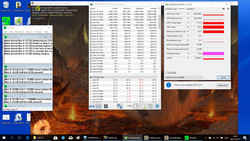
The stress tests via Prime 95 and FurMark testify the throttling. Afterward simply a brief fourth dimension, the graphics card is throttled from about 1200 MHz down to 405 MHz, and the storage speed even drops to 203 MHz. In this way, the GPU temperature stays at 72 °C (~162 °F), which would exit some head room. The processor levels out at a clock speed of about 2 GHz, and the core temperatures lie at around 80 °C (~176 °F). Dell probably throttles the performance of the Inspiron this much in order to proceed a comfortable temperature. After the stress exam, the fans remain very active for a long time.
| Dell Inspiron xv 7570 GeForce 940MX, i5-8550U, Samsung PM961 NVMe MZVLW512HMJP | Asus Vivobook S15 S510UQ-BQ189T GeForce 940MX, i5-7200U, Toshiba SG5 THNSNK128GVN8 | Acer TravelMate P658-G2-MG-7327 GeForce 940MX, i7-7500U, Liteonit CV3-8D512 | Lenovo IdeaPad 510-15IKB 80SV0087GE GeForce 940MX, i7-7500U, Liteonit CV3-DE256 | Huawei MateBook D 15, i7-7500U 940MX GeForce 940MX, i7-7500U, SanDisk SD8SN8U128G1027 | Dell Inspiron fifteen 5000 5567-1753 Radeon R7 M445, i7-7500U, SanDisk X400 SED 256GB, SATA (SD8TB8U-256G) | |
|---|---|---|---|---|---|---|
| Heat | 3% | -5% | x% | -11% | -11% | |
| Maximum Upper Side * | 42.viii | 38.2 11% | 46.4 -viii% | 38.3 11% | 44.8 -5% | 41.half dozen 3% |
| Maximum Bottom * | 43 | 49 -xiv% | 51.3 -19% | 36 16% | l.four -17% | 51.3 -19% |
| Idle Upper Side * | 27.8 | 24.7 11% | 26 6% | 24.9 10% | 29.4 -6% | 29.4 -half-dozen% |
| Idle Bottom * | 26.6 | 25.8 3% | 25.vii 3% | 25.6 four% | 31 -17% | 32.4 -22% |
* ... smaller is better
| |||||||||||||||||||||||||
| Maximum: 42.viii °C = 109 F Average: 34.nine °C = 95 F | |||||||||||||||||||||||||
| |||||||||||||||||||||||||
| Maximum: 43 °C = 109 F Average: 33.nine °C = 93 F | |||||||||||||||||||||||||
Power Supply (max.) 46.4 °C = 116 F | Room Temperature 22.7 °C = 73 F | FIRT 550-Pocket
| |||||||||||||||||||||||||
| Maximum: 27.8 °C = 82 F Average: 25.five °C = 78 F | |||||||||||||||||||||||||
| |||||||||||||||||||||||||
| Maximum: 26.half dozen °C = 80 F Average: 25.v °C = 78 F | |||||||||||||||||||||||||
Ability Supply (max.) 28.1 °C = 83 F | Room Temperature 20.6 °C = 69 F | FIRT 550-Pocket
(±) The boilerplate temperature for the upper side under maximal load is 34.9 °C / 95 F, compared to the average of 29.four °C / 85 F for the devices in the class Office.
(±) The maximum temperature on the upper side is 42.8 °C / 109 F, compared to the average of 34 °C / 93 F, ranging from 21.2 to 62.5 °C for the grade Function.
(±) The bottom heats up to a maximum of 43 °C / 109 F, compared to the average of 36.6 °C / 98 F
(+) In idle usage, the boilerplate temperature for the upper side is 25.5 °C / 78 F, compared to the device average of 29.4 °C / 85 F.
(+) The palmrests and touchpad are libation than skin temperature with a maximum of 29.5 °C / 85.1 F and are therefore cool to the bear on.
(±) The average temperature of the palmrest area of similar devices was 27.8 °C / 82 F (-i.7 °C / -iii.1 F).
As with so many notebooks, the sound reproduction cannot convince in this notebook either. The maximum volume is not particularly loftier, and the bass reproduction is worse than mediocre. The sound spectrum is thin and not enjoyable.
You can connect external sound devices such as headphones, a stereo organization, or microphone via the combined headphone/microphone port.
Dell Inspiron 15 7570 audio analysis
(-) | not very loud speakers (67.4 dB)
Bass 100 - 315 Hz
(-) | near no bass - on average xviii.2% lower than median
(±) | linearity of bass is average (thirteen.one% delta to prev. frequency)
Mids 400 - 2000 Hz
(+) | balanced mids - only 3.five% abroad from median
(±) | linearity of mids is average (8.1% delta to prev. frequency)
Highs two - 16 kHz
(+) | counterbalanced highs - only two.3% away from median
(±) | linearity of highs is boilerplate (ix.9% delta to prev. frequency)
Overall 100 - 16.000 Hz
(±) | linearity of overall sound is boilerplate (17.9% divergence to median)
Compared to same class
» 29% of all tested devices in this class were better, 8% similar, 63% worse
» The all-time had a delta of 7%, average was 21%, worst was 51%
Compared to all devices tested
» 34% of all tested devices were better, viii% similar, 58% worse
» The best had a delta of three%, average was 20%, worst was 65%
Apple MacBook 12 (Early on 2016) 1.1 GHz sound analysis
(+) | speakers can play relatively loud (83.6 dB)
Bass 100 - 315 Hz
(±) | reduced bass - on average 11.3% lower than median
(±) | linearity of bass is average (14.2% delta to prev. frequency)
Mids 400 - 2000 Hz
(+) | counterbalanced mids - merely 2.4% away from median
(+) | mids are linear (five.5% delta to prev. frequency)
Highs 2 - 16 kHz
(+) | balanced highs - only 2% abroad from median
(+) | highs are linear (4.v% delta to prev. frequency)
Overall 100 - xvi.000 Hz
(+) | overall sound is linear (9.three% departure to median)
Compared to same grade
» 2% of all tested devices in this grade were ameliorate, one% similar, 97% worse
» The best had a delta of 7%, boilerplate was nineteen%, worst was fifty%
Compared to all devices tested
» 2% of all tested devices were meliorate, 1% similar, 97% worse
» The best had a delta of 3%, average was twenty%, worst was 65%
Frequency comparison (Checkboxes selectable!)
While idling, the Inspiron is efficient. Thanks to Optimus and the very variable processor speed, it keeps upwardly with the competition. Under load, the motion picture changes slightly. Despite the relatively strong performance throttling, our test unit consumes more than ability than virtually of the competitors during very demanding work. Only the Acer and the sibling model swallow a similar amount during maximum load. We measured a top value of 59 watts. The included power supply is rated at 65 watts, which should be sufficient.
| Dell Inspiron 15 7570 i5-8550U, GeForce 940MX, Samsung PM961 NVMe MZVLW512HMJP, IPS, 1920x1080, 15.60 | Asus Vivobook S15 S510UQ-BQ189T i5-7200U, GeForce 940MX, Toshiba SG5 THNSNK128GVN8, IPS, 1920x1080, xv.sixty | Acer TravelMate P658-G2-MG-7327 i7-7500U, GeForce 940MX, Liteonit CV3-8D512, IPS, 1920x1080, xv.threescore | Lenovo IdeaPad 510-15IKB 80SV0087GE i7-7500U, GeForce 940MX, Liteonit CV3-DE256, IPS, 1920x1080, 15.lx | Huawei MateBook D 15, i7-7500U 940MX i7-7500U, GeForce 940MX, SanDisk SD8SN8U128G1027, IPS, 1920x1080, xv.60 | Dell Inspiron 15 5000 5567-1753 i7-7500U, Radeon R7 M445, SanDisk X400 SED 256GB, SATA (SD8TB8U-256G), TN LED, 1920x1080, 15.threescore | |
|---|---|---|---|---|---|---|
| Power Consumption | two% | -vii% | v% | -6% | 6% | |
| Idle Minimum * | 3.6 | 3.6 -0% | 3.ix -8% | 3.9 -8% | 5.xiv -43% | four -xi% |
| Idle Average * | half-dozen.vii | 6.8 -1% | vii.9 -18% | 7.4 -10% | ix.07 -35% | 5.4 19% |
| Idle Maximum * | 9.2 | nine.5 -3% | 11.3 -23% | nine.5 -three% | ix.33 -1% | 8.3 x% |
| Load Boilerplate * | 59 | 51.6 13% | 47 20% | 41 31% | 46.76 21% | 54 8% |
| Load Maximum * | 58 | 56 iii% | 62 -7% | 48 17% | 42.59 27% | 55.4 4% |
| Witcher 3 ultra * | 40.18 |
* ... smaller is better
The Inspiron xv has a 42-Wh battery. To establish how long the device can last abroad from the mains outlet, nosotros test various scenarios.
For the maximum runtime, nosotros deactivate all the communication modules, minimize the effulgence, and actuate power saving manner. Nosotros simulate a minimal load via the BatteryEater read benchmark. In this way, our examination unit lasts for a maximum of 4 hours and twoscore minutes. For an all-rounder with such born hardware, this is anything simply a elevation value. In the comparison, this is only sufficient for the final identify. The next best competitors last almost twice as long. However, since the Acer and Lenovo lack some important measurement data, they are dropping out of the comparison.
To measure the minimum runtime, nosotros turn upwards all the power users and simulate a big load with the BatteryEater Archetype test. The Inspiron lasts for simply ane hour and 20 minutes. Even though all the competitors come out close together here, this measurement is annihilation merely satisfactory.
We activate the Balanced mode in the WLAN do test, reduce the brightness to 150 cd/g2, and surf the spider web with changing pages via a script. The examination unit achieves a runtime of one hour and 45 minutes, which is quite subterranean for a notebook of this price range.
In our video test, the Inspiron achieves nigh 4 hours. The ability saver mode was active, the advice modules deactivated, only the brightness was maximized.
Overall, the battery life of the Inspiron 15 is a negative surprise. Although the device is relatively light and offers Optimus and an energy efficient processor, the measured runtimes are very weak, which clearly limits the mobility that it has aimed for. Considering the hardware, it is a mystery to us every bit to why the device does and then badly here.
Bombardment Runtime
| Idle (without WLAN, min brightness) | 4h 40min | |
| WiFi Websurfing (Border) | 1h 45min | |
| Big Cadet Bunny H.264 1080p | 4h 00min | |
| Load (maximum brightness) | 1h 20min |
| Dell Inspiron 15 7570 i5-8550U, GeForce 940MX, 42 Wh | Asus Vivobook S15 S510UQ-BQ189T i5-7200U, GeForce 940MX, 42 Wh | Acer TravelMate P658-G2-MG-7327 i7-7500U, GeForce 940MX, 55 Wh | Lenovo IdeaPad 510-15IKB 80SV0087GE i7-7500U, GeForce 940MX, 30 Wh | Huawei MateBook D 15, i7-7500U 940MX i7-7500U, GeForce 940MX, 43.3 Wh | Dell Inspiron 15 5000 5567-1753 i7-7500U, Radeon R7 M445, 42 Wh | |
|---|---|---|---|---|---|---|
| Bombardment Runtime | 61% | 382% | 162% | 192% | 104% | |
| Reader / Idle | 280 | 423 51% | 956 241% | 466 66% | ||
| H.264 | 240 | 316 32% | ||||
| WiFi v1.3 | 105 | 255 143% | 506 382% | 275 162% | 441 320% | 417 297% |
| Load | 80 | 71 -xi% | 93 sixteen% | 95 19% |
Pros
+ sturdy aluminum case
+ good contrast and black value
+ hardware easily accessible via bottom cover
+ backlit keyboard
+ CPU of the 8th Intel generation
+ very good SSD
+ e'er stays absurd
Cons
- bad menu reader
- no Thunderbolt 3
- no number pad
- loud clicking noises
- latencies and drop outs
- bad graphics performance and throttling
- fan nether load and high-frequency fan racket
- bad battery life
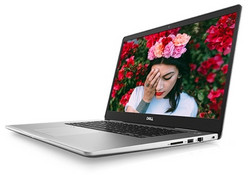
The Inspiron 15 7000 (7570-9726) is a difficult case. On the one hand, we like the design and workmanship all around the sturdy aluminum instance. Despite the reflective surface, the display likewise strikes a very good figure in some parts, and at least on paper, the hardware convinces with expert values, particularly the excellent SSD. In addition, the device always stays comfortably absurd.
On the other mitt, the Dell Inspiron has some weaknesses, some of which cannot be explained. The worst are the very poor battery life, every bit well as the measured latencies and drop outs. Patently the device struggles with some peachy driver issues, since the graphics performance is too heavily throttled. In the organization and particularly graphics performance, the device does not reach the level of the competitors and cannot fill up use of the potential promised by the good hardware. Only that alone would non exist so bad, if at least the mobility would have been better with a skilful battery life. Later all, the device is a low-cal business organisation or all-circular model. Unfortunately the opposite is the instance.
While the Dell Inspiron has good prerequisites in terms of strong components, unfortunately by having surprising weaknesses, it messes up its justified promises of a top value.
Currently, the device can exist purchased for a price of about 1150 Euros (~$1324; starting at $750 in the US). Users for whom the graphics operation is less of import and who expect for a adept notebook for their home are still well-served by the Dell Inspiron. Perhaps Dell can manage to remedy some of the worst weaknesses through updates. We would wish information technology, since so the device would as well exist suitable for more than mobile usage tasks.
Dell Inspiron 15 7570 - 2017-xi-08 11/08/2017 v6(one-time)
Christian Hintze
Office - Weighted Average
Pricecompare

A C64 marked my entry into the world of PCs. I spent my student internship in the repair department of a computer shop and at the end of the day I was allowed to assemble my ain 486 PC from "workshop remnants". As a result of this, I later studied informatics at the Humboldt University in Berlin, with psychology besides being added to my studies. Subsequently my get-go job as a research banana at the academy, I went to London for a year and worked for Sega in figurer game translation quality balls. This included working on games such equally Sonic & All-Stars Racing Transformed and Company of Heroes. I have been writing for Notebookcheck since 2017.
Christian Hintze, 2017-11-14 (Update: 2019-03-31)
Source: https://www.notebookcheck.net/Dell-Inspiron-15-7570-i7-8550U-940MX-Laptop-Review.263654.0.html
0 Response to "I7 8550u 512gb Ssd 16gb Dell Inspiron Review"
Post a Comment